
Visa Direct (AFT and OCT)
Last updated: October 19, 2026
Important
Visa AFT / OCT addresses a specific category of merchants. Support is therefore available only for some card connectors and for specific use cases. Check the feature support in each connector integration sheet and contact our support team if needed.
Visa Direct benefits
Visa Direct is a payment service that enables real-time money transfers, quickly and securely, over Visa’s global network. It lets a business move funds from its own account to a customer’s account.
It is a popular way for businesses to send money to customers, and it is also used for peer-to-peer (P2P) and business-to-business (B2B) payments. Comparable payment solutions can take up to 24 hours to deliver the money to the recipient, whereas Visa Direct transactions are designed to complete almost instantly, in up to 30 minutes.
Visa is one of the world’s largest payment networks, so Visa Direct benefits from its extensive global reach: money can be sent to and received from millions of accounts around the world. For merchants, it is a way to scale the business and to speed up international payments.
- One transaction, many uses: supports money transfers, digital wallet transfers, instant deposits, prepaid loads, credit card bill payments and more.
- Trust: funds are submitted only to Visa accounts that were issued following appropriate Know Your Customer (KYC) procedures.
- Global reach: reaches financial institutions and Visa cardholders across the world.
- Convenience: consumers receive funds directly into their Visa card account and can then use them at ATMs and at merchants that accept Visa cards.
- Speed: consumers get access to the funds within 30 minutes or less of issuer approval of the transaction.
- Ease of use: funds are sent directly to an existing Visa card account of the consumer’s choice.
- Currency handling: VisaNet provides currency conversion and transaction settlement over multiple currencies.
AFT and OCT services
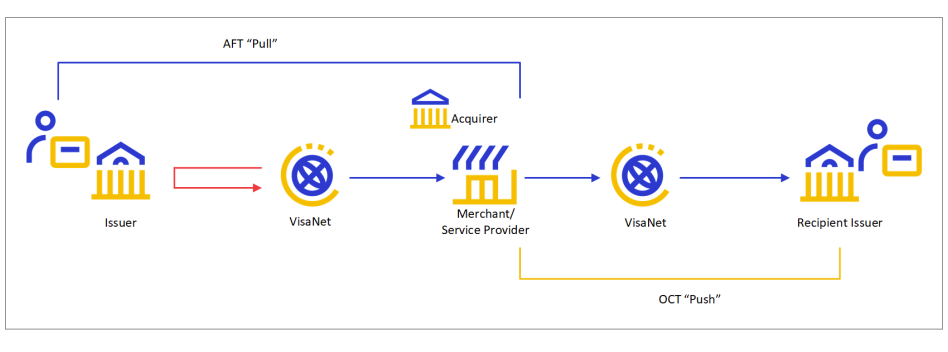
Visa Direct uses two complementary transaction types: an Account Funding Transaction (AFT) pulls funds from a Visa account, and an Original Credit Transaction (OCT) pushes funds to an eligible Visa card.
Figure 1: AFT “pull” and OCT “push” flow
What are AFT and OCT?
AFT (Account Funding Transaction) is a transaction in which funds are pulled from a Visa account and are subsequently used to fund another Visa or non-Visa account. When an AFT is used independently to fund another Visa or non-Visa account, it must only be used to fund an account that belongs to the same individual or entity that holds the Visa account.
OCT (Original Credit Transaction) is a transaction used to send funds to an eligible Visa card. An OCT alone cannot be used for the purchase of goods or services (this does not apply to Request to Pay Consumer-to-Small-Business (C2B) use cases). OCTs are not allowed for merchandise return credits or refunds, except by exception or in alignment with the Visa rules.
Possible scenarios
The following examples show how AFTs, which pull funds, and OCTs, which push funds, work together.
Money transfer services (peer-to-peer payments)
- AFT: a customer uses a money transfer app (for example PayPal) to send money to another person. The app initiates an AFT to fund the transaction by pulling money from the customer’s Visa account.
- OCT: once the transaction is processed, the app uses an OCT to push the funds into the recipient’s Visa account.
Gig economy platforms (driver payouts)
- AFT: a rideshare driver (for example using Uber) requests a transfer of their earnings to their Visa card. The platform first initiates an AFT to fund the transaction from the platform’s pool account.
- OCT: the platform then processes an OCT to credit the driver’s Visa account with the earnings.
Gaming or betting payouts
- AFT: a user deposits money into an online gaming or betting platform using their Visa card. The deposit is facilitated through an AFT.
- OCT: if the user wins and requests a payout, the gaming platform sends the winnings to the user’s Visa card through an OCT.
Cash-out from investment platforms
- AFT: a customer uses their Visa card to fund their investment account through an AFT.
- OCT: when the customer requests to cash out their earnings or returns, the platform credits their Visa card through an OCT.
E-wallet funding and withdrawal
- AFT: a customer adds funds to their digital wallet (for example Google Pay or Apple Pay) using their Visa card. The transaction is processed as an AFT.
- OCT: if the customer decides to withdraw funds from the wallet back to their Visa account, the wallet service initiates an OCT.
OCT service flows
There are two potential flows for OCT-based services.
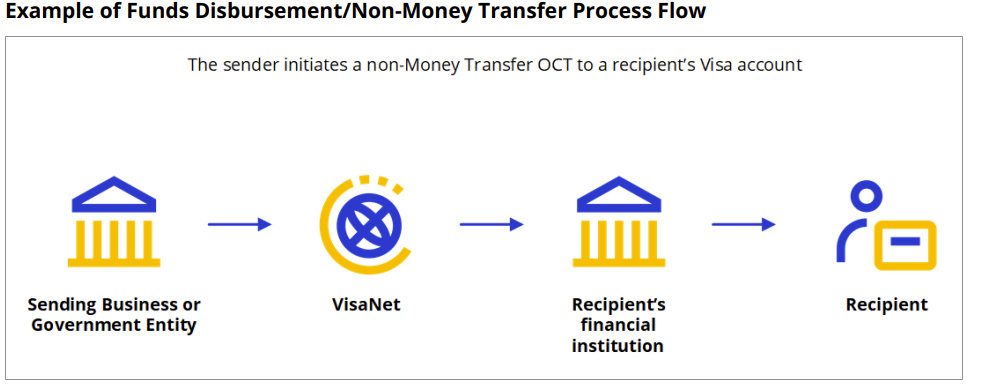
Funds disbursement / non-money transfer
Examples are funds disbursement (including merchant settlement, and loyalty and offers), prepaid load, and credit card bill payment. In this flow, the sender or merchant is the business or government entity that disburses funds to a Visa card account holder.
- Funds disbursement: enables merchants, government entities or corporations to send funds to a Visa account. Examples include insurance claims, corporate and manufacturing rebates, affiliate and contractor payouts, expense reimbursements, government disbursements (such as value-added tax refunds), and online gambling and lottery payouts.
- Loyalty and offers: pays a loyalty reward or merchant offer onto a card using the OCT, as part of a loyalty program.
- Prepaid load: lets consumers add value to an eligible Visa reloadable prepaid card.
- Merchant settlement: acquirers, or third-party agent service providers, use the OCT to speed up settlement payments between acquirers or payment facilitators and their merchants.
- Credit card bill payment: lets consumers pay a credit card bill.
Figure 2: Example funds disbursement / non-money transfer process flow
Money transfer
- Money transfer: enables consumers to send funds to their own Visa account or to another consumer’s Visa account.
- Digital wallets: enables faster payments that move funds out of a digital wallet and deliver them to a cardholder’s Visa account.
- Instant deposit: converts a check into a digital payment that is delivered to a cardholder’s Visa account.
Figure 3: Example card-to-card P2P money transfer process flow
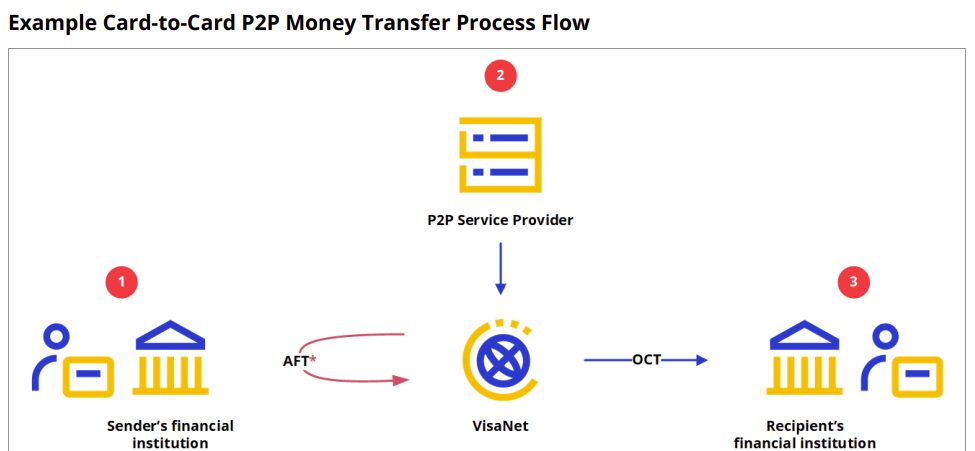
Note: if a Visa account is used to fund the OCT, acquirers, service providers and merchants must process the funding transaction as an AFT.
Original Credit Transaction vs. Credit Transaction
- If the intention is to initiate a transaction that results in a credit to a payment credential or bank account, without a prior purchase (except when used for a Faster Refund), the Visa rules consider it an Original Credit Transaction.
- If the intention is to process a transaction, or a Faster Refund, that represents a merchant’s refund or price adjustment credited to a cardholder’s account, the Visa rules consider it a Credit Transaction.
Merchant transaction policies
AFT vs. purchase transactions
Not all purchase transactions sent by an eligible MCC are considered AFTs. Visa differentiates them as follows:
- AFT identification: Account Funding Transactions are identified by Visa through Field 3 (Processing Code) with the value
10(Account funding). - Purchase transactions: are identified by Visa through the Processing Code value
00(Goods/service purchase–debit).
Key fields for differentiation in V.I.P.
Field | Value | Description |
|---|---|---|
Field 3 | 00 | Purchase transactions |
Field 3 | 10 | Account funding transactions (AFT) |
BASE II TCR | Position 3, TCQ 0 | Purchase transactions |
BASE II TCR | Position 3, TCQ 1 | Account funding transactions (AFT) |
OCT vs. payment transactions
Not all payment transactions sent by an eligible MCC are considered OCTs. Visa differentiates them as follows:
- OCT identification: Original Credit Transactions are identified by Visa through Field 3 (Processing Code) with the value
26(Original credit). - Payment transactions: are identified by Visa through other Processing Code values that are not specific to OCT.
Key fields for differentiation in V.I.P.
Field | Value | Description |
|---|---|---|
Field 3 | 26 | Original credit transactions (OCT) |
Field 3 | Other values | Regular payment transactions |
Visa registration
Acquirers and their agents must ensure that all Visa licenses, registrations, notifications, authorizations and approvals needed to engage in AFT / OCT programs are obtained from the appropriate authorities in the originating entity’s jurisdiction.
Next steps
To configure and send AFT and OCT transactions, including the eligible Business Application IDs (BAI), Merchant Category Codes (MCC) and the required API parameters, see the Visa Direct (AFT and OCT) integration guide.
Visa documents
The following Visa guides contain the complete scheme requirements: